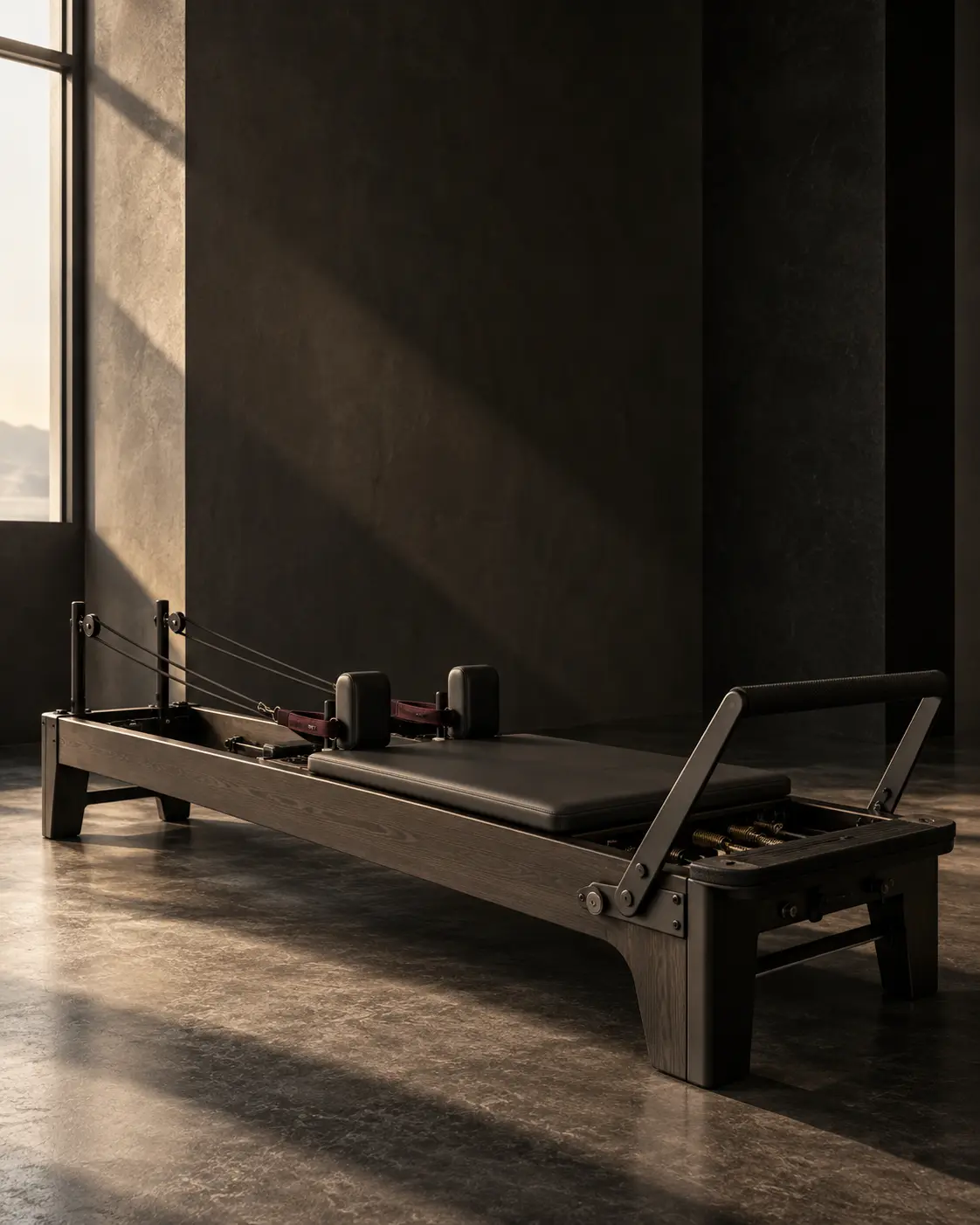
The reformer makes an impression. Springs, a carriage, straps – a machine that, at first glance, looks more at home in a workshop than a gym. A mat, by contrast, is just a mat. It’s understandable that many people assume the reformer is the ‘serious’ form of Pilates and matwork is merely the warm-up. That is a misconception, and one worth clearing up before you choose a class.
What the reformer offers
A reformer has a carriage that moves along rails and is connected to the frame by springs. The springs do two things at once: they provide resistance when you push the carriage away and assistance when they draw it back. The same spring can therefore make an exercise more challenging or easier – depending on what we ask it to do.
This offers three practical benefits.
Feedback. The movement of the carriage immediately reveals uneven effort, when one side is working harder than the other, or when a movement is jerky. The machine does not lie.
Adjustability. Changing the spring setting can make the same exercise easier or more challenging without having to find a different exercise. This is especially useful for someone who is just starting out, or when a particular movement cannot yet be performed cleanly.
Support. In certain exercises performed lying down or seated, the carriage and straps can provide support or guidance; in other positions, they challenge your balance instead.
What matwork offers
On the mat, there are no springs, no carriage and no feedback from a machine. There is only your own body and gravity. This makes the work both more challenging and more honest: there is nowhere to hide. If your centre does not provide support, the movement falls apart – and you can feel it.
One advantage of matwork is that it can be done anywhere, and it teaches you to create for yourself the control that the machine partly provides on the reformer. The control developed on the mat transfers well to the reformer; at the same time, the two challenge movement in different ways.
The same method
The key point is that Pilates does not reside in the equipment. Breathing, the position of the pelvis and rib cage, shoulder-blade stability and control of the movement are the same on the mat and on the reformer. The equipment only changes how much assistance and feedback you receive along the way.
How to choose
If you are just starting out and have the opportunity, the reformer can be a good entry point: the support and springs help you feel what controlled movement means. If you already have experience, the mat will show you how fully that control is your own.
Most of the time, the best answer is both. In my classes, the two are not alternatives but checks on each other: what the reformer teaches, the mat puts to the test.