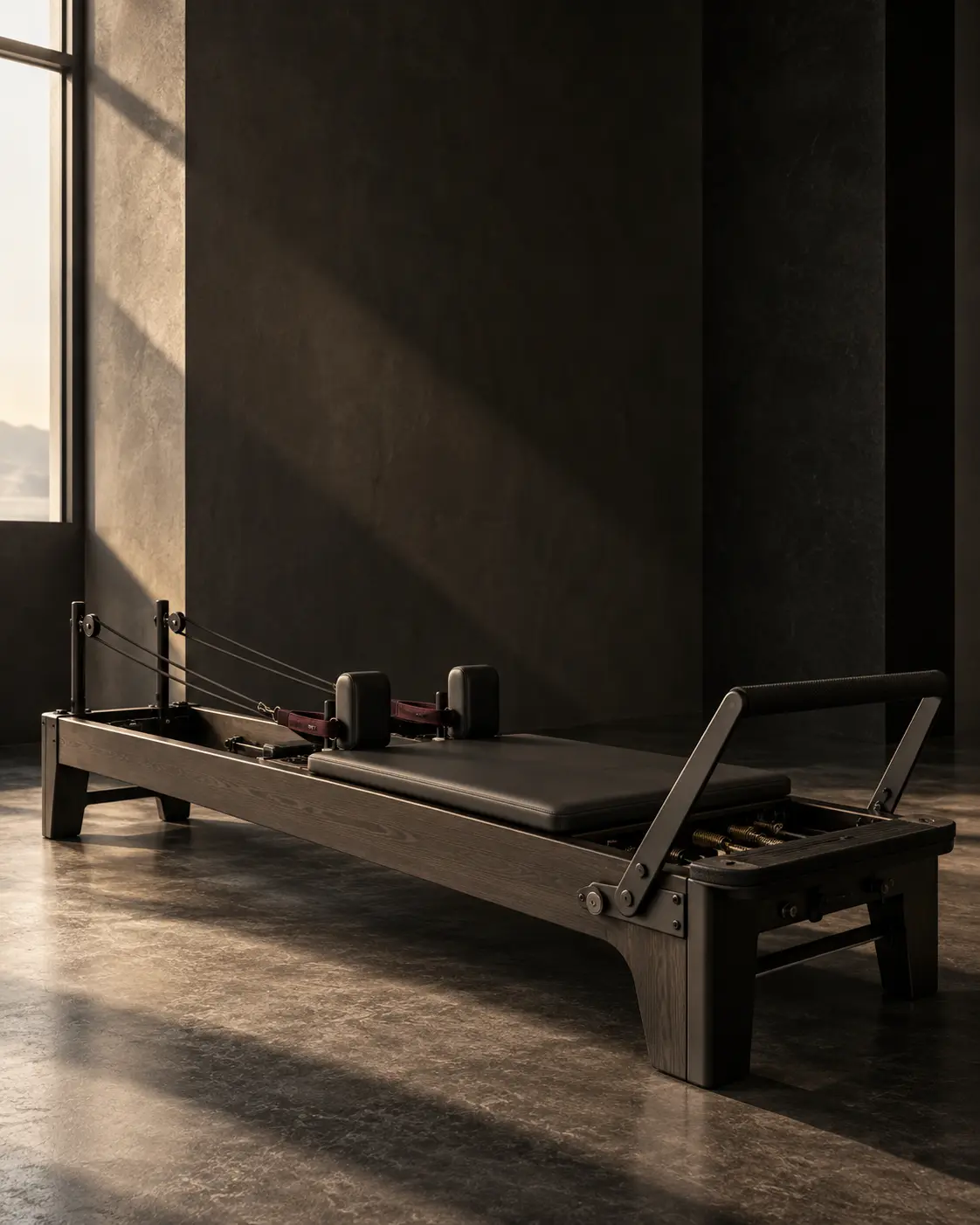
When someone first hears about STOTT Pilates, two questions usually come up: is this different from ‘regular’ Pilates, and if so, how? The short answer is: the same roots, but a different language and a different emphasis.
Where it begins
Joseph Pilates developed his method in the first half of the twentieth century and called it ‘Contrology’. The exercises, the equipment — including the reformer — and the underlying idea that the quality of movement matters more than quantity all originated with him.
STOTT Pilates is a contemporary version of this system. From the late 1980s onwards in Toronto, Lindsay G. Merrithew and Moira Merrithew further developed the system in collaboration with physiotherapists and professionals in sports medicine and fitness. Their aim was to preserve the original repertoire of exercises while adapting their execution to what we now know about loading the spine, joints and muscles.
The five basic principles
The STOTT method builds every exercise around five basic principles. I will return to them again and again in class, because they are not introductory material — they are the work itself.
- Breathing. Lateral breathing that expands the rib cage and supports, rather than hinders, trunk stability.
- Pelvic placement. Neutral or imprint — a slightly tilted position — depending on what the exercise and the individual body require.
- Rib cage placement. The ribs should not ‘flare’ — the rib cage and pelvis remain aligned in relation to one another.
- Scapular movement and stability. The shoulder girdle does not rise towards the ears, but it does not become rigid either.
- Head and cervical spine placement. The neck is a continuation of the spine, not a separate unit.
How it differs from classical Pilates
The most visible difference is the way the spine is approached. Some classical approaches ask for a flatter lower-back position in certain exercises; wherever possible, the STOTT approach begins by maintaining the spine’s natural curves and departs from them only when there is a reason to do so. This may sound like a small detail, but in practice it means that an exercise has several progressive variations, and your body determines which one is right for you today.
Another difference is the training system. STOTT PILATES training is modular, with separate Matwork and Reformer courses. The Certified Instructor designation requires an examination, and maintaining current status requires 0.6 CECs — six hours of continuing education — each year. When you read ‘STOTT Pilates instructor’ on an instructor’s website, it is worth checking which modules they have completed and where.
Why I chose it
Because the method does not ask how many you can do, but how you do them. Progress is not shown by moving on to a more difficult exercise, but by performing the same exercise with greater precision, calm and strength. This approach matches how I think about strength training, and it is also the foundation of FANNI FORM.
If you are new to Pilates, do not choose based on the name alone. Pay attention to how the instructor talks about movement and try a class. The first twenty minutes will tell you more than any description.